The Fields of the Audiovisual Sector
The audiovisual supply chain, as classified by the official statistic institutions, can be analyzed and classified according to its different areas of activity, from Production to Post-production, all the way to Distribution and Exhibition of products for cinema and television. The need to group the supply chain according to these last two fields (cinema and television) has led this study to adopt an original method, aimed at linking each of the 7,247 companies with one of the two.
In order to make the most of the statistical and info sources, the quantification of the two sub-sectors that are being analyzed (television and cinema) was obtained by means of five distinct researches. The first was related to business objectives. Data-mining techniques made it possible to identify specific connotations within the business objectives of each company thanks to matching techniques among terms considered specific to the field of reference – whether television, cinema or mixed media.
Criteria used for the internal division of the audiovisual sector and share of absorption of businesses
| Research | Criterion | Businesses coverage | Employees coverage |
| Business objectives | Selection of a set of 56 words in three classes (cinema, TV, mixed) | 96% | 96% |
| Secondary Ateco classes | Univocal Ateco presence (59.14 o 60.20) among secondary Ateco classes | 93% | 97% |
| Activity description | Presence of words such as “Cine” or “Tele/tv” | 91% | 93% |
| Websites | Website analysis | 31% | 78% |
| Tax Credit | Mibact funds for Film&TV products | 7% | 23% |
Secondly, the analysis of secondary activities offered the possibility to better position the nature of the activity carried out by a company: the presence of one of the two univocal fields – cinema and television – steered the identification of a company’s area of action.
Thirdly, the activity description of the company (information that can be found in the Chamber of Commerce registers) was analyzed, offering further information on the field of action of each company. Also in this case, the textual analysis outlined each company according to three groups (cinema, television or mixed media).
List of strings used for the analysis of business objectives:
- AUDIOVISUAL word list (mixed): animation, attori, attrici, audiovis, audiovideo, backstage, cartone_animat, cartoni_animat, cartoon, casting, cineaudiovis, cineradio, cinetele, cinevideo, colonne_sonore, commedie, cooproduzion, coproduzion, coreografici, cortometragg, costumeria, costumisti, costumistica, doppiaggi, film, lungometragg, mediometragg, mixag, pellicol, postproduzion, regia, regista, registi, sceneggiat, sottotitolat, telecinema, videoanimazione, videocassett, videocinema;
- CINEMA word list: audiocine, cinefilia, cinefotografico, cinema, multisale, proiettati, videohome, videoclip;
- TELEVISION word list: documentari, fiction, palins, reality, reportage, serie_tv, sitcom, soap_opera, televis.
The fourth type of analysis concerned the objective analysis of the activities and projects carried out by each company starting from an investigation of their internet websites, where present. Finally, the investigation analyzed the annual data on government funds granted in the form of tax credit together with the nature of the projects financed for each company.
Breakdown of the added value and employment in the audiovisual sector by field: film, tv and mixed activities
Year 2017 (added value and employment)
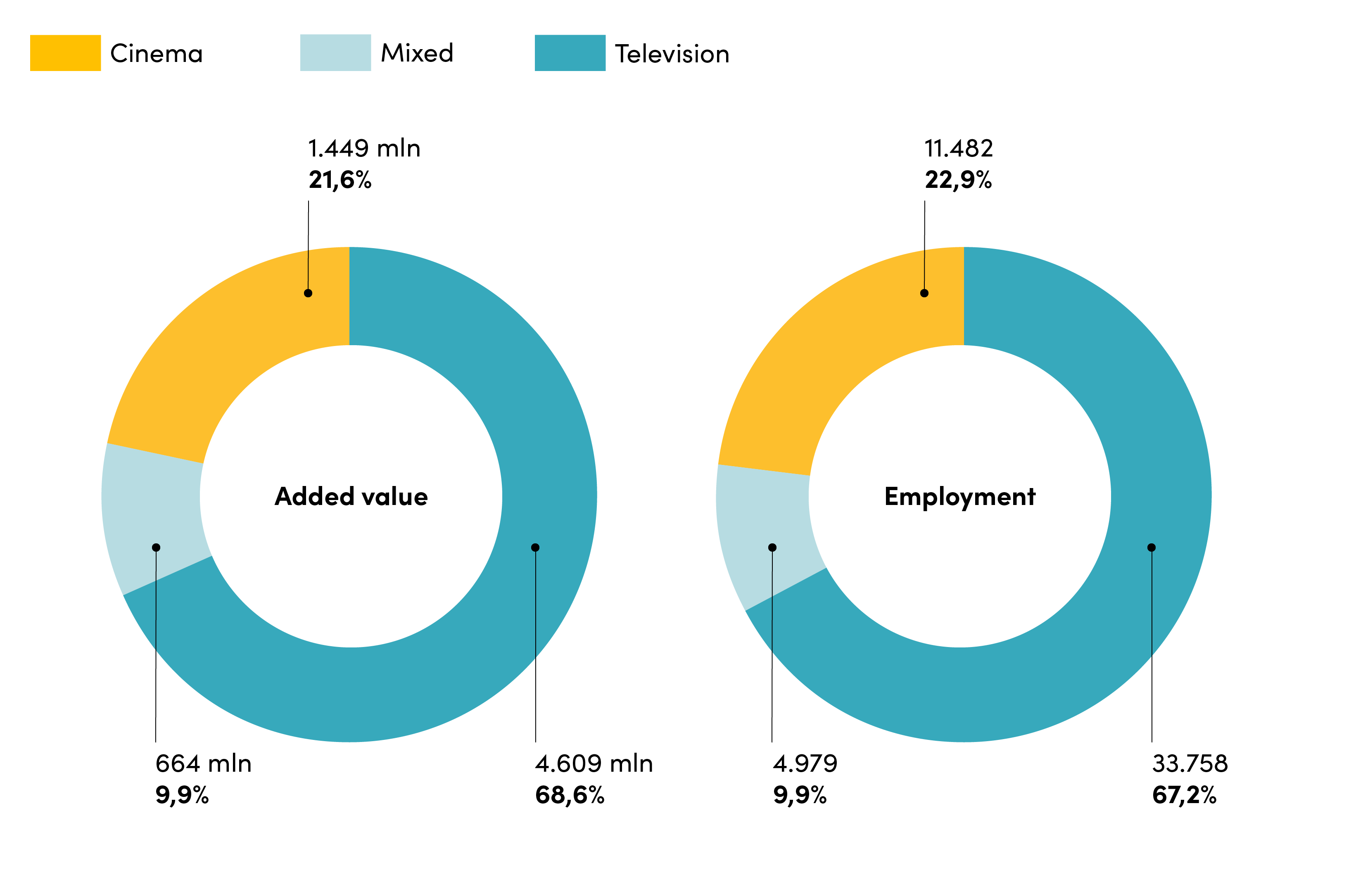
Source: Symbola Foundation
The summary of the five studies carried out allowed each company to be assigned to one of the three sector groups (cinema, television or mixed). From this grouping it was possible to re-elaborate distinct added values and employment data. Specifically, the audiovisual sector appears to be made up of companies that operate mainly in the television business; approximately two thirds of the entire added value produced, in fact, belong to these (4,609 million euros; 68.6%).
Breakdown of the added value and employment in the audiovisual sector* by categories and fields
Year 2017 (absolute value and percentage variations)
| Ateco | Ateco category | M€ | Fields | ||
| Cinema | Television | Mixed | |||
| 5911 | Film, video & TV shows production | 1.913 | 529 | 881 | 504 |
| 5912 | Film, video & TV shows post-production | 330 | 90 | 120 | 119 |
| 5913 | Film, video & TV shows distribution | 178 | 107 | 31 | 41 |
| 5914 | Exhibition | 724 | 724 | 0 | 0 |
| 6020 | TV programming and broadcasting | 3.577 | 0 | 3.577 | 0 |
| TOTAL AUDIOVISUAL INDUSTRY | 6.721 | 1.449 | 4.609 | 664 | |
| PERCENTAGE COMPOSITIONS | 100,0 | 21,6 | 68,6 | 9,9 |
Source: Symbola Foundation estimates
Breakdown of the added value and employment in the audiovisual sector* by categories and fields
Year 2017 (absolute value and percentage variations)
| Ateco | Ateco category | Employees | Allocation | ||
| Cinema | Television | Mixed | |||
| 5911 | Film, video & TV shows production | 14.475 | 3.999 | 6.666 | 3.810 |
| 5912 | Film, video & TV shows post-production | 2.409 | 659 | 878 | 872 |
| 5913 | Film, video & TV shows distribution | 1.295 | 776 | 223 | 297 |
| 5914 | Exhibition | 6.048 | 6.048 | 0 | 0 |
| 6020 | TV programming and broadcasting | 25.992 | 0 | 25.992 | 0 |
| TOTAL AUDIOVISUAL INDUSTRY | 50.219 | 11.482 | 33.758 | 4.979 | |
| PERCENTAGE COMPOSITIONS | 100,0 | 22,9 | 67,2 | 9,9 |
Source: Symbola Foundation estimates
Il tax credit è un credito d’imposta gestito dal Mibac che permette di agevolare le produzioni dei settori dell’audiovisivo relativamente alle opere cinematografiche e televisive.
The companies that work mainly in the motion picture industry, on the other hand, contribute by 21.6% or slightly less than 1.5 billion euros. Finally, a residual share of 9.9% is owed to companies that operate equally within both classes.
In terms of employees, the figures remain practically unchanged, with the role of predominantly television companies falling slightly (67.2%; 33,758 employees) and that of cinema growing at the same pace (22.9%; 11.482 employed). The mixed area, featuring companies without a particular prevalence of typology, continues to account for 9.9% (just under 5,000 employees out of a total of over 50,200).