An analysis of firm stillbirth rate at the Business Register
To face the present and upcoming moment, up-to-date statistics are crucial. The Business Register figures at the Chambers of Commerce offer a statistic picture on a quarterly and monthly basis, thus submitting constantly updated data on firm entries and exits.
The 2020 available data in this report (and the annual variation) analyzes registered companies and the flows of entries and exits divided by sector of economic activity and geography.
This report offers a detailed statistic framework referring to the economic activities that fall within the fields of Cinema and Television. What emerges is a specific area that can be defined as the audiovisual industry core, which includes the following activities to the fourth digit of the national classification of economic activities (Ateco 2007):
- 59.11 Theatrical, video & TV production activities;
- 59.12 Theatrical, video & TV post-production activities;
- 59.13 Theatrical, video & TV distribution activities;
- 59.14 Theatrical activities;
- 60.20 TV programming and broadcasting activities.
In April 2020, over hearings on initiatives to support the industrial, trade, and tourism sectors due to the economic situation following the COVID-19 emergency, Unioncamere had already highlighted the first signs of the effects of the pandemic on firm birth rates in March, already anticipating those for April. These predictions were eventually confirmed throughout 2020 and allow us to outline the shape of the audiovisual supply chain.
The most notable figures were the fall of business registrations and the stagnation of business cancellations. The drop in entries was determined by two factors: logistic difficulties during the lockdown and over the last few months of 2020 and the investors’ loss of confidence in the immediate future. The “freezing” of cancellations, on the other hand, conceals a phenomenon that has not yet fully produced its final effects, which are expected to take place this year. On the other hand, the impossibility of firing employees and welfare support has kept alive those companies that would have hardly made it in free-market conditions, thus postponing the crisis within the statistical data of the Business Register.
This information can be translated into figures, both for Italy and for the specific sector of the audiovisual core.
In 2020, in Italy, the number of registration entries decreased by 292,308 units. This figure is lower than 60K units than the previous year when registration entries were above 353K. The worst trend (the negative peak) relates to the second quarter, with over 34K fewer registration entries due to the lockdown.
The drop in entries on the Italian territory was matched by an almost similar downsizing in the number of exits. During the year, cancellations totaled 307,686, meaning ± 55K less than in 2019, when over 362K cancellations were recorded at the Business Register. Firm exits in 2020 took place mainly during the first quarter, therefore ahead of the crisis. To date (May 2021), the figure seems to be stable, which is the result of the measures imposed by the government to reduce unemployment and support entrepreneurship, increasing the survival levels even for companies in serious difficulty, which have postponed their official cancellation, at least for the moment. With the natural shrinking of the extraordinary measures, the data on firm exits should grow significantly, perhaps around the end of 2021, with some evidence that could be seen over the next few months.
Tab. 1 – Business entries and exits within the audiovisual core
Years 2011, 2018, 2019 e 2020 (absolute value)
Entries
| Ateco | Ateco Classification | 2011 | 2018 | 2019 | 2020 |
| 5911 | Theatrical, video & TV production activities | 269 | 265 | 264 | 218 |
| 5912 | Theatrical, video & TV post-production activities | 32 | 36 | 66 | 48 |
| 5913 | Theatrical, video & TV distribution activities | 2 | 6 | 0 | 4 |
| 5914 | Theatrical activities | 21 | 11 | 9 | 13 |
| 6020 | TV programming & broadcasting activities | 9 | 10 | 8 | 7 |
| AV CORE | Audiovisual CORE | 333 | 328 | 347 | 290 |
| TOTAL | TOTAL ECONOMY | 391.310 | 348.492 | 353.052 | 292.308 |
Exits
| Ateco | Ateco Classification | 2011 | 2018 | 2019 | 2020 |
| 5911 | Theatrical, video & TV production activities | 491 | 339 | 369 | 402 |
| 5912 | Theatrical, video & TV post-production activities | 20 | 32 | 39 | 32 |
| 5913 | Theatrical, video & TV distribution activities | 28 | 24 | 13 | 23 |
| 5914 | Theatrical activities | 100 | 38 | 57 | 35 |
| 6020 | TV programming & broadcasting activities | 9 | 14 | 21 | 15 |
| AV CORE | Audiovisual CORE | 648 | 447 | 499 | 507 |
| TOTAL | TOTAL ECONOMY | 393.463 | 340.715 | 362.218 | 307.686 |
Source: Symbola Foundation elaborations on Infocamere data
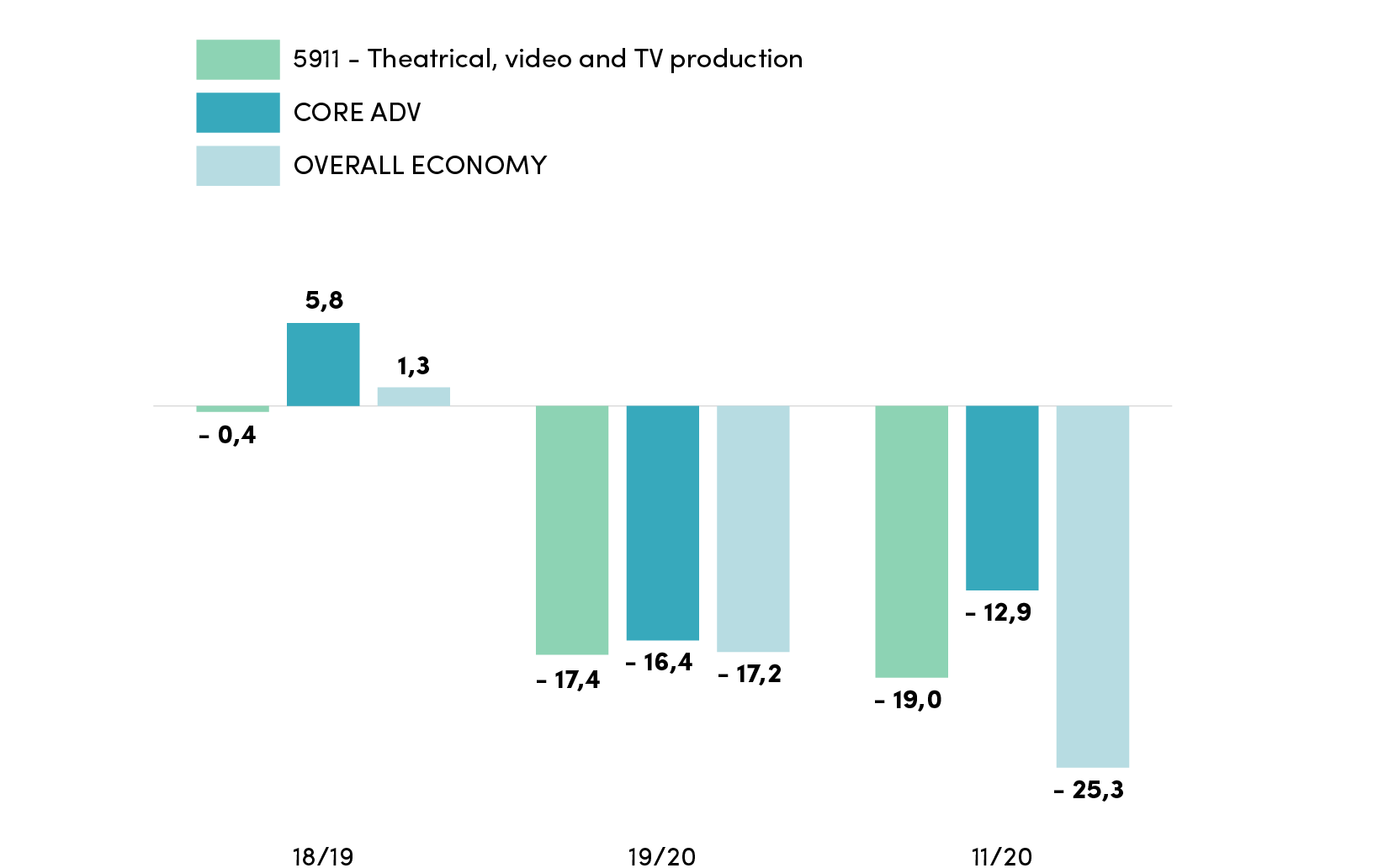
In this context, the audiovisual industry seems to confirm the theory mentioned above with some exceptions. In terms of entries, the 290 companies registered during 2020 are -57 compared to the same figure in 2019. In percentage, this is substantially in line with the overall data of the Italian economy (-16, 4% vs. -17.2%).
Within the audiovisual core sectors, businesses operating in production (Ateco 5911) and post-production activities (Ateco 5912) reveal a more evident decline in registrations (-46 and -18). In particular, the production activities (Ateco 5911) indicate a 46.0% decrease in entries over the current year. On the other hand, other sectors do not show a further decline, as data is substantially in line with the previous year.
Graphic 1 – Audiovisual core: trends in registrations
Year 2020 (percentage variations during the first eight months of 2020)
Source: Symbola Foundation elaborations on Infocamere data
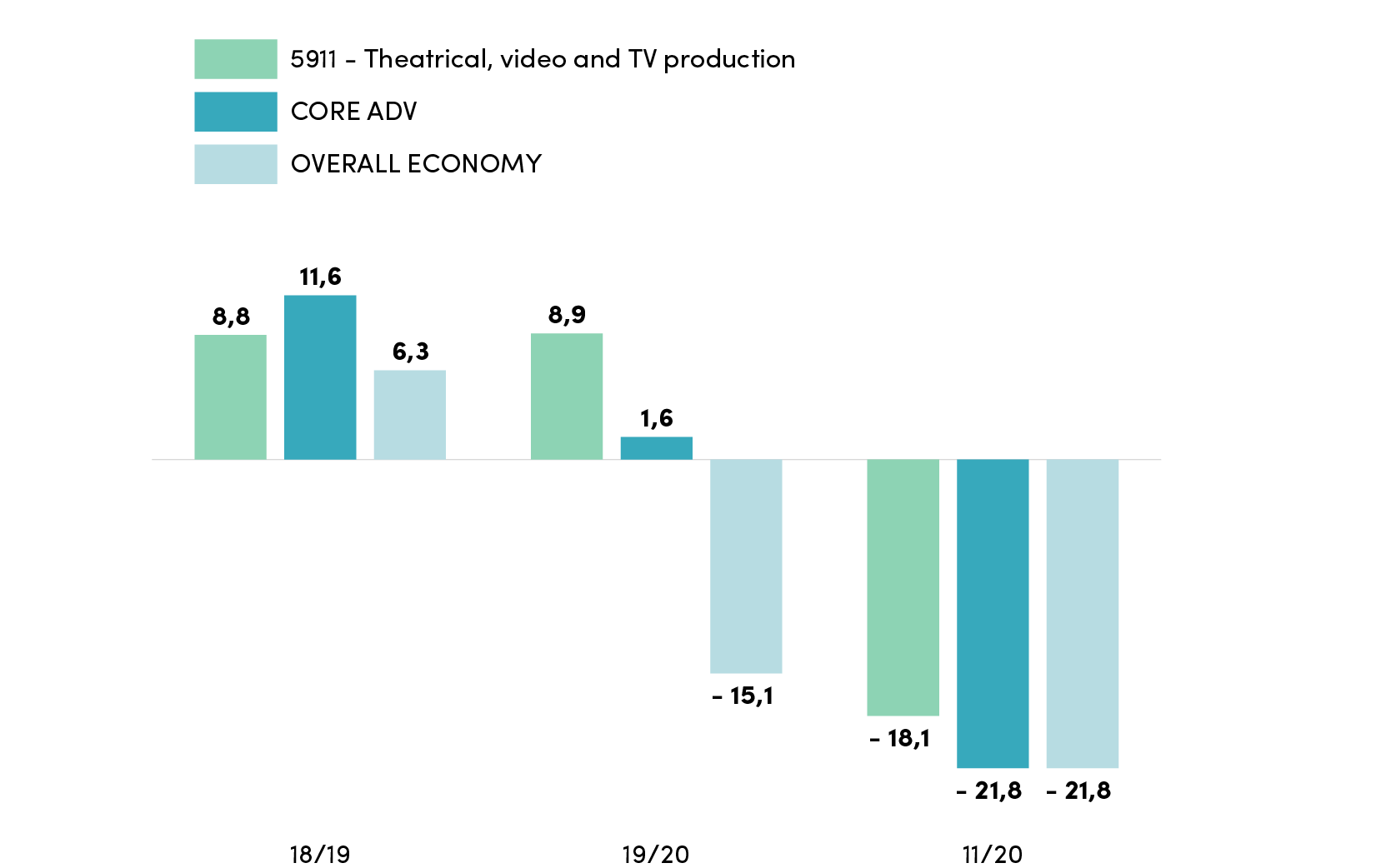
Despite analogies in the entry dynamics, business cancellations reveal discrepancies when compared to the overall Italian economy. In contrast to -15.1% exits related to the entire economy, there has been a substantial countertrend growth within the audiovisual core (+8.9%,) confirmed even by the Theatrical&TV production activities (Ateco 5911) alone (+1.6%). These different performances related to 2020 ease the differences stored up over the previous years, providing nearly similar long-term dynamics (2011/2020: -21.8%; -18.1%, production alone).
Graphic 2 – Audiovisual core: trends in cancellations
Year 2020 (percentage variations during the first eight months of 2020)
Source: Symbola Foundation elaborations on Infocamere data
Regional entries in Veneto (from 17 to 25) and Campania (from 14 to 18) show an opposite trend compared to the domestic supply chain. Lazio reveals a particularly negative impact on exits (from 118 to 186). In contrast, the number of cancellations in Lombardy was reduced from 135 to 97 in just twelve months, going opposite the domestic average.
Table 2 – Breakdown of audiovisual entries and exits by Italian regions
Year 2011, 2018, 2019 e 2020 (absolute values)
| Registrations | Cancellations | |||||||
| Region | 2011 | 2018 | 2019 | 2020 | 2011 | 2018 | 2019 | 2020 |
| Piedmont | 27 | 19 | 33 | 23 | 33 | 35 | 34 | 25 |
| Valled’Aosta | 0 | 1 | 1 | 2 | 5 | 0 | 0 | 0 |
| Lombardy | 59 | 67 | 78 | 67 | 142 | 69 | 135 | 97 |
| Trentino-Alto Adige | 7 | 22 | 23 | 11 | 12 | 14 | 10 | 10 |
| Friuli-Venezia Giulia | 6 | 13 | 4 | 5 | 9 | 7 | 6 | 2 |
| Veneto | 22 | 24 | 17 | 25 | 21 | 30 | 28 | 32 |
| Liguria | 8 | 8 | 9 | 6 | 13 | 10 | 9 | 8 |
| Emilia-Romagna | 34 | 26 | 33 | 25 | 52 | 35 | 30 | 25 |
| Tuscany | 26 | 25 | 24 | 22 | 40 | 18 | 28 | 35 |
| Umbria | 6 | 4 | 2 | 4 | 6 | 4 | 4 | 1 |
| Marche | 15 | 14 | 12 | 6 | 15 | 15 | 8 | 8 |
| Lazio | 44 | 42 | 46 | 44 | 148 | 117 | 118 | 186 |
| Abruzzo | 13 | 5 | 7 | 3 | 18 | 4 | 7 | 8 |
| Molise | 2 | 3 | 2 | 2 | 4 | 0 | 3 | 0 |
| Campania | 14 | 11 | 14 | 18 | 36 | 23 | 25 | 27 |
| Apulia | 22 | 15 | 16 | 15 | 20 | 30 | 15 | 12 |
| Basilicata | 5 | 3 | 3 | 0 | 4 | 3 | 2 | 2 |
| Calabria | 4 | 5 | 5 | 1 | 6 | 6 | 6 | 6 |
| Sicily | 15 | 14 | 12 | 8 | 48 | 22 | 21 | 17 |
| Sardinia | 4 | 7 | 6 | 3 | 16 | 5 | 10 | 6 |
| ITALY | 333 | 328 | 347 | 290 | 648 | 447 | 499 | 507 |
Source: Symbola Foundation elaborations on Infocamere data
[1] Enrollment in the Chamber of Commerce Business Register is a mandatory “one-off” administrative procedure defined at the start of a company. It consists of two phases: the first, where a digitally signed application is submitted electronically within 30 days from the start of the activity; the second, where the application is verified and proceeds to registration.
[2] Termination or cancellation from the Business Register is an administrative procedure following a liquidation procedure of a partnership or capital company. Cancellation is a mandatory step explicitly imposed by law for joint stock companies. However, partnerships cancellations have been much discussed by theories and the law.
[3] Recent notes from the Chamber of Commerice refer to 350,000 companies in great difficulty marked by worrying behavioral indicators (Unioncamere, Study Center of the Guglielmo Tagliacarne Chambers of Commerce, Screenshot of the economy – 25 snapshots on the year of the pandemic crisis and on the prospects for recovery, April 28, 2021).
[4] Expanding the pandemic crisis to 13 months, the loss of new businesses is estimated at 63,000:
https://www.unioncamere.gov.it/P42A4767C160S123/la-pandemia-frena-la-natalit%EF%BF%BD-delle-imprese–dal-primo-lockdown-aperte-63mila-aziende-in-inò .htm.