Breakdown of the audiovisual core chain: cinema, television, and mixed activities
Breakdown of the audiovisual core chain: cinema, television, and mixed activities
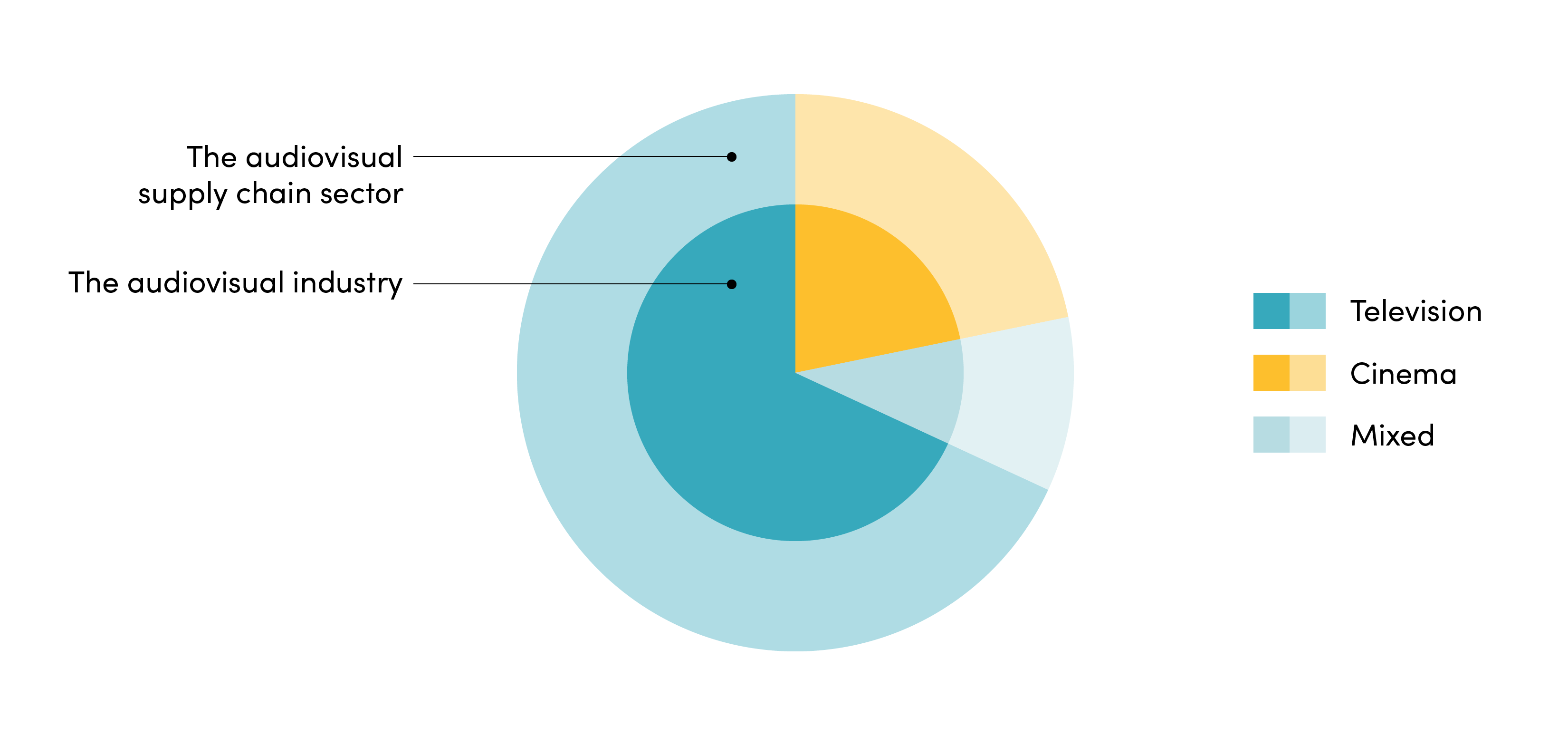
As classified by the official statistic institutions, the audiovisual supply chain can be analyzed and classified according to its different areas of activity, from Production to Post-production, all the way to Distribution and Exhibition of products for cinema and television. The need to group the supply chain according to these two fields (cinema and television) has led this study to adopt an original method, aimed at linking each of the businesses with one of the two.
In order to make the most of the statistical sources and information, the figure count of the two fields (television and cinema) was obtained by means of five distinct researches. The first was related to business objectives. Data-mining techniques made it possible to identify specific connotations within the business objectives of each company thanks to matching techniques among words considered specific to the field of reference – whether television, cinema, or mixed media.
Criteria used for the profiling of the audiovisual core sectors and the business absorption rate
| Analysis | Criterion | Businesses coverage | Employees coverage |
| Business objectives | Selection of a set of 56 words in the three classes (cinema, TV, mixed) | 96% | 96% |
| Secondary Ateco classes | Univocal Ateco class (59.14 o 60.20) among secondary Ateco classes | 93% | 97% |
| Activity description | Presence of words such as “Cine” or “Tele/tv” | 91% | 93% |
| Websites | Website analysis | 31% | 78% |
| Tax Credit | Mibact funds for Film&TV products | 7% | 23% |
Secondly, the analysis of secondary activities offered the possibility to better position the nature of the activity carried out by a company: the presence of one of the two univocal fields – cinema and television (10) – steered the identification of a company’s area of action.
Thirdly, the activity description of the company (information that can be found in the Chamber of Commerce registers) was analyzed, offering further information on the field of action of each company. Once again, the textual analysis made it possible to outline each company according to the three groups (cinema, television or mixed media).
(10) Among the 5 Ateco classes, only two are completely and univocally part of one of the two main industries of the supply chain: 5914 solely for the film industry; 6020 solely for the television industry.
List of strings used in analyzing business objectives:
- List of words for AUDIOVISUAL (mixed): animation, attori, attrici, audiovis, audiovideo, backstage, cartone_animat, cartoni_animat, cartoon, casting, cineaudiovis, cineradio, cinetele, cinevideo, colonne_sonore, commedie, cooproduzion, coproduzion, coreografici, cortometragg, costumeria, costumisti, costumistica, doppiaggi, film, lungometragg, mediometragg, mixag, pellicol, postproduzion, regia, regista, registi, sceneggiat, sottotitolat, telecinema, videoanimazione, videocassett, videocinema;
- List of words for CINEMA: audiocine, cinefilia, cinefotografico, cinema, multisale, proiettati, videohome, videoclip;
- List of words for TELEVISION: documentari, fiction, palins, reality, report, serie_tv, sitcom, soap_opera, televis.
The fourth type of analysis concerned the objective analysis of the activities and projects carried out by each company starting from exploiting their internet websites, where present. Finally, the investigation analyzed the annual data on government funds granted in the form of tax credit (11) together with the nature of the projects financed for each company.
The summary of the five studies carried out allowed each company to be assigned to one of the three groups of the Film&TV fields (Ateco 5911, 5912, 5913,) and eventually compute the employment and added values data. The univocal attribution of the two other classes (5914 – Exhibition; 6020 – TV programming & broadcasting) then made it possible to redistribute the estimated data of the previous chapter.
(11) Tax credit is a credit on tax managed by Mibact that supports productions in the audiovisual sector in relation to theatrical and television products.